
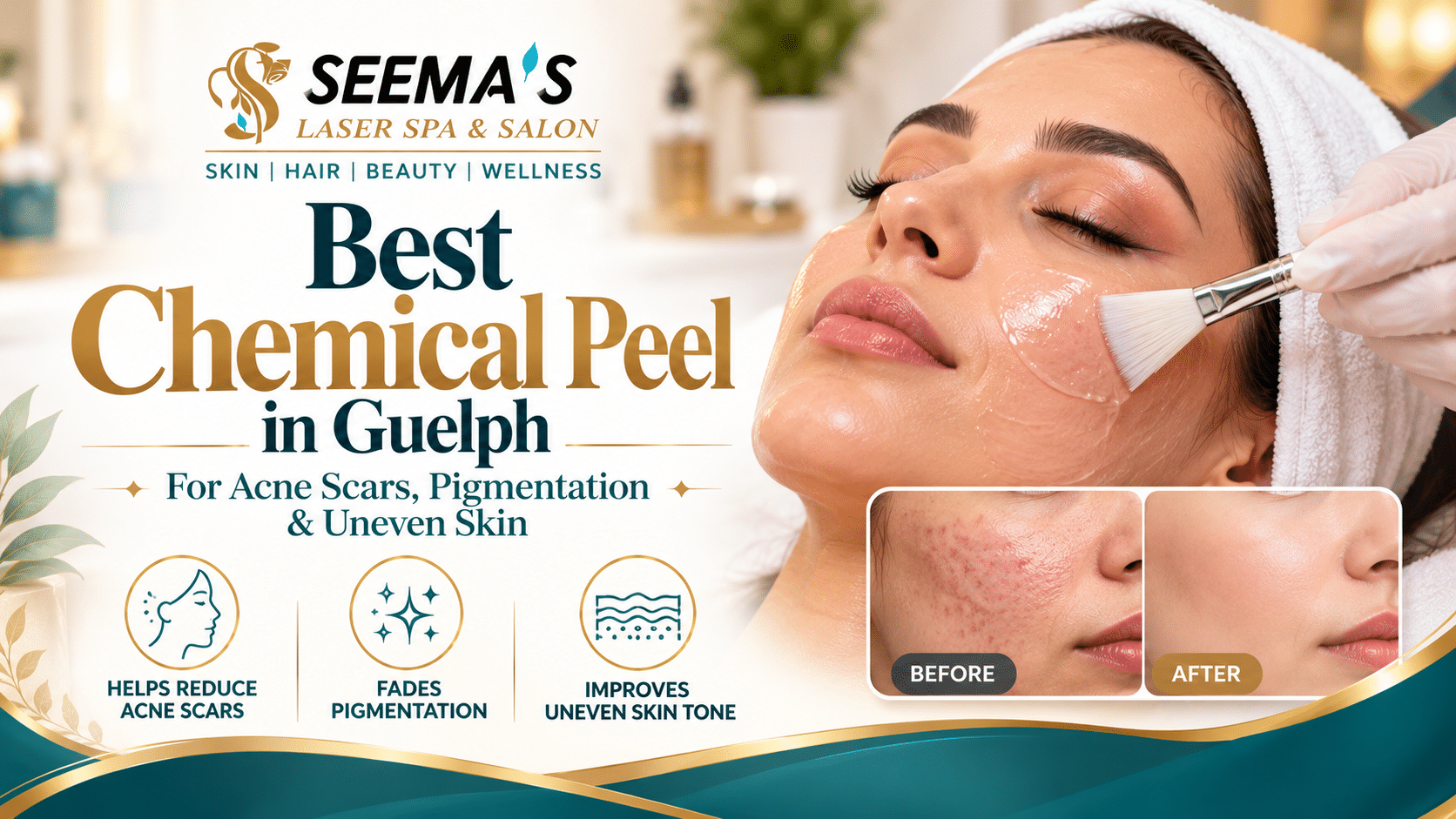
If your skin looks different in October than it did in April — more uneven, more pigmented, more congested, or more dull — you are not imagining it. Three months of summer sun exposure in Guelph has left its mark. UV-triggered pigmentation, accumulated congestion, post-breakout marks that darkened in the summer heat, and an overall uneven tone that was not there at the start of the season.
October is the month when all of that becomes most visible — and most motivating.
It is also — and this is the part most people do not know — the single best month of the entire year to get a chemical peel in Guelph. Not because there is anything magical about October specifically, but because chemical peels require conditions that autumn naturally provides: low UV exposure, covered skin, and the time for multiple sessions before the next summer arrives.
At Seema’s Laser Spa & Salon in Guelph we offer professional chemical peel treatments tailored to your specific skin concern — acne scars, pigmentation, uneven tone, rough texture, or a combination of all of them. This guide covers everything you need to know before you book.
What Is a Chemical Peel?
A chemical peel is a professional skin treatment that applies a specifically formulated acid solution to the skin surface — dissolving the bonds that hold dead, damaged, and discoloured skin cells together and triggering controlled exfoliation at a depth determined by the type and concentration of acid used.
Unlike physical exfoliation — microdermabrasion or scrubs — which removes dead cells mechanically from the outer surface, a chemical peel works through a biochemical process that can be calibrated to reach different depths within the skin. This depth calibration is what makes chemical peels so versatile — the same treatment concept can be adjusted to address surface dullness in a superficial peel or reach into the upper dermis with a medium-depth peel to address more established pigmentation and scarring.
The exfoliation triggered by a chemical peel also stimulates cell turnover and — in medium-depth peels — collagen production in the upper dermis. This means a chemical peel does not simply remove damaged cells from the surface. It actively stimulates the generation of healthier, more even, more collagen-rich skin to replace them.
Types of Chemical Peels Available at Seema’s in Guelph
Understanding the different peel types is essential to choosing the right treatment for your specific skin concern — because a peel that is ideal for surface brightening is not the same treatment as one designed to address post-acne marks or deeper pigmentation.
Superficial Peels — AHA and BHA Peels
AHA Peels (Alpha-Hydroxy Acids):
The most commonly used superficial peels — including glycolic acid (derived from sugar cane) and lactic acid (derived from milk). AHA peels work at the epidermis level, accelerating cell turnover and breaking down the bonds between dead surface cells. They are well-suited to general brightening, mild pigmentation improvement, surface texture refinement, and overall skin renewal.
Glycolic acid is the most penetrating of the AHAs — making it the most effective for surface pigmentation and texture. Lactic acid is gentler and better suited to sensitive skin types while still delivering meaningful brightening results.
BHA Peels (Beta-Hydroxy Acids):
Salicylic acid is the primary BHA used in professional peels. Unlike AHAs which are water-soluble and work at the skin surface, salicylic acid is oil-soluble — meaning it penetrates into the pore itself rather than just working on the outer skin surface. This makes BHA peels particularly effective for acne-prone and congested skin — clearing sebum buildup from within the pore, reducing active breakouts, and addressing the congestion that contributes to post-acne marks.
Medium-Depth Peels — TCA Peels
TCA Peels (Trichloroacetic Acid):
Medium-depth peels that penetrate through the epidermis into the upper dermis — reaching the level where more established pigmentation deposits, deeper post-acne marks, and significant texture irregularities originate. TCA peels produce a more significant exfoliation response than AHA or BHA peels — with visible peeling over 3 to 7 days — but deliver meaningfully deeper and longer-lasting improvement for clients with more stubborn skin concerns.
TCA peels stimulate collagen production in the upper dermis as part of the healing response — producing skin that is not just cleared of surface damage but actively rebuilt with newer, healthier dermal tissue.
Best Chemical Peel for Acne Scars in Guelph
Acne scars are one of the most searched skin concerns in Guelph — and one of the most frustrating because they persist long after the breakouts that caused them have resolved. Understanding which type of acne scarring you have is the first step to choosing the right peel.
Post-inflammatory hyperpigmentation (PIH) — flat dark marks:
These are the most common form of post-acne marks — flat, brown or dark spots left behind after a pimple heals. They are not true scars (no textural change) but discolouration caused by excess melanin production triggered by the inflammation of the original breakout.
Best peel for PIH: A glycolic acid AHA peel series accelerates the cell turnover that gradually clears PIH marks — with 4 to 6 sessions showing significant improvement. For more established or deeper PIH marks, a medium-depth TCA peel penetrates to the pigment deposit level for more direct improvement.
Post-inflammatory erythema (PIE) — flat red or pink marks:
Red or pink marks left after acne — caused by dilated blood vessels in the area of the original breakout rather than excess melanin. PIE fades naturally over time but professional treatment accelerates the process.
Best peel for PIE: A salicylic acid BHA peel combined with anti-inflammatory actives reduces the vascular reactivity driving PIE while simultaneously addressing any ongoing congestion that might be generating new marks.
Textural acne scars — pitted or depressed:
True structural scars involving textural change — including ice-pick, boxcar, and rolling scars. These involve dermal tissue loss and require treatments that reach the dermis to produce meaningful improvement.
Honest assessment: Superficial chemical peels produce limited improvement on true textural acne scars because they work primarily at the epidermis level. A medium-depth TCA peel can produce moderate improvement by stimulating collagen in the upper dermis. For significant improvement in deep textural acne scars, Secret RF microneedling at Seema’s — which reaches 3.5mm depth — is a more appropriate treatment. Your consultation at Seema’s will honestly assess your scar type and recommend the most effective treatment option.
Best Chemical Peel for Pigmentation in Guelph
Pigmentation — including sun spots, melasma, and general uneven skin tone — is the most common reason Guelph clients book a chemical peel in autumn. After three months of summer UV exposure, pigmentation that was manageable in spring is now significantly darker and more visible in October.
Sun spots and solar lentigines:
Well-defined, round or oval brown spots on areas with the most sun exposure history — face, hands, décolletage, and shoulders. Caused by localised accumulation of UV-triggered melanin production.
Best peel for sun spots: A glycolic acid AHA peel series accelerates cell turnover and progressively clears the surface pigmentation deposits. For more established or stubborn sun spots, a TCA peel penetrates to the deeper pigment layers for more complete clearance. Red Touch Laser Therapy at Seema’s is also highly effective for discrete sun spots.
Melasma and hormonal pigmentation:
Symmetrical patches on the cheeks, forehead, and upper lip driven by a combination of UV exposure and hormonal factors. Melasma is the most complex form of pigmentation to treat because standard peels address the visible surface pigment without interrupting the enzyme mechanism that is continuously generating new pigment beneath it.
Honest assessment: Chemical peels can improve the visible appearance of melasma — particularly in autumn when UV stimulation has reduced — but they do not address the root enzyme mechanism of melasma in the way that Dermamelan treatment at Seema’s does. For true melasma, Dermamelan is the clinically superior treatment. Your consultation will confirm whether a chemical peel or Dermamelan is the right choice for your specific pigmentation pattern.
Post-inflammatory hyperpigmentation:
Dark marks from acne, eczema, or any skin injury — driven by excess melanin production triggered by inflammation. Responds well to salicylic acid and glycolic acid peels through the accelerated cell turnover mechanism.
Why October Is the Best Month for a Chemical Peel in Guelph
This is the seasonal argument that makes October uniquely valuable for chemical peel treatment — and it is one that most Guelph clinics are simply not communicating to their clients.
Reason 1 — UV Exposure Is at Its Lowest
Chemical peels require strict sun avoidance for 1 to 2 weeks after each session — because freshly peeled skin is significantly more photosensitive and vulnerable to UV-triggered pigmentation than intact skin. Attempting to maintain sun avoidance in June or July in Guelph is genuinely challenging — UV levels are at their peak, days are long, and lifestyle sun exposure is unavoidable.
October through February in Guelph provides the lowest UV index of the entire year — and the natural inclination toward covered skin, shorter days, and reduced outdoor time means the post-peel sun avoidance protocol is almost automatically maintained without lifestyle disruption.
Reason 2 — Skin Is at Its Most Motivating Condition
The cumulative effects of summer UV exposure are at their most visible in October — making this the month when clients are most motivated to address pigmentation, uneven tone, and congestion. Booking when motivation is highest is directly correlated with treatment compliance and completing the full recommended series of sessions.
Reason 3 — A Full Series Completes Before Next Summer
A recommended series of 4 to 6 chemical peel sessions spaced 3 to 4 weeks apart takes 3 to 5 months to complete. Starting in October means completing the full series between January and March — with fully healed, renewed skin emerging just as spring UV begins to rise again. This is the most strategically perfect result timing available for any peel course.
Reason 4 — Results Compound Through the Lowest UV Season
Each chemical peel session produces improvement — but the most significant results come from the cumulative effect of multiple sessions, each one building on the cell turnover and collagen stimulation of the previous one. Running a peel series through the lowest UV season means each session’s improvement is protected and preserved rather than competing against ongoing UV-triggered pigmentation.
How Many Chemical Peel Sessions Do I Need in Guelph?
For surface brightening and mild pigmentation:
4 to 6 AHA peel sessions spaced 3 to 4 weeks apart. Progressive improvement with each session — most clients notice meaningful change after session 2 to 3 and significant overall improvement after completing the full series.
For moderate pigmentation and post-acne marks:
4 to 6 sessions — potentially with a medium-depth TCA peel incorporated after initial AHA sessions have prepared the skin. Your specialist at Seema’s will assess progression after each session and adjust the peel depth accordingly.
For significant uneven tone or more established sun damage:
A TCA peel series of 3 to 4 sessions spaced 6 to 8 weeks apart — allowing sufficient healing time between medium-depth sessions for maximum improvement per session.
Maintenance:
After completing an initial series, most clients maintain their results with 1 to 2 sessions per year — typically in autumn and late winter — to manage new UV pigmentation before it becomes established.
Can Chemical Peels Be Combined With Other Treatments at Seema’s?
Yes — and the most comprehensive skin improvement results consistently come from combining chemical peels with complementary treatments that address different depths of skin concern simultaneously:
- Hydradermabrasion — surface hydration and barrier repair between peel sessions
- Secret RF Microneedling — deep dermal collagen remodelling for textural acne scars that peels cannot reach
- Dermamelan Treatment — for true melasma that requires enzyme-level depigmentation
- Red Touch Laser Therapy — for discrete sun spots and redness alongside broader peel treatment
Your consultation at Seema’s will assess your complete skin picture and recommend the most effective combination of treatments for your specific concerns — rather than a single approach that addresses only part of what your skin needs.
How Much Does a Chemical Peel Cost in Guelph?
Chemical peel pricing at Seema’s varies based on the peel type selected — superficial AHA or BHA versus medium-depth TCA — and whether individual sessions or a package of sessions is booked. Package pricing offers significantly better value per session than individual bookings and is recommended for clients committing to a full course.
A free consultation at Seema’s will assess your skin, confirm the most appropriate peel type and depth for your concerns, and provide completely transparent pricing before any treatment commitment is made.
Why Choose Seema’s for Chemical Peels in Guelph
- Professional-grade peel formulations — not the diluted versions available in home kits
- 20+ years of skin treatment experience across all skin types and tones
- Safe for darker skin tones — peel type and depth carefully selected for all complexions
- Personalised assessment — right peel type recommended for your specific skin concern
- Free consultation before any treatment commitment
- Full advanced treatment menu — chemical peels combined with Secret RF, Dermamelan, or Red Touch for comprehensive results
- 250+ five-star Google reviews from verified Guelph clients
- Conveniently located at Hartsland Market Square, 210 Kortright Rd W, Guelph
- Welcoming clients from Guelph, Kitchener, Waterloo, and Cambridge
Book Your Chemical Peel Appointment in Guelph Today
October is open. UV is low. Summer pigmentation is visible and motivating. And the window to complete a full chemical peel series before next summer is exactly the right length.
If your skin has been telling you it needs professional attention since summer ended — this is the month to act on it.
Address: 210 Kortright Rd W, Guelph, Ontario N1G 4X8
(Inside Hartsland Market Square)
Phone: +1 519-829-0876
Email: seema@seemaspa.com