
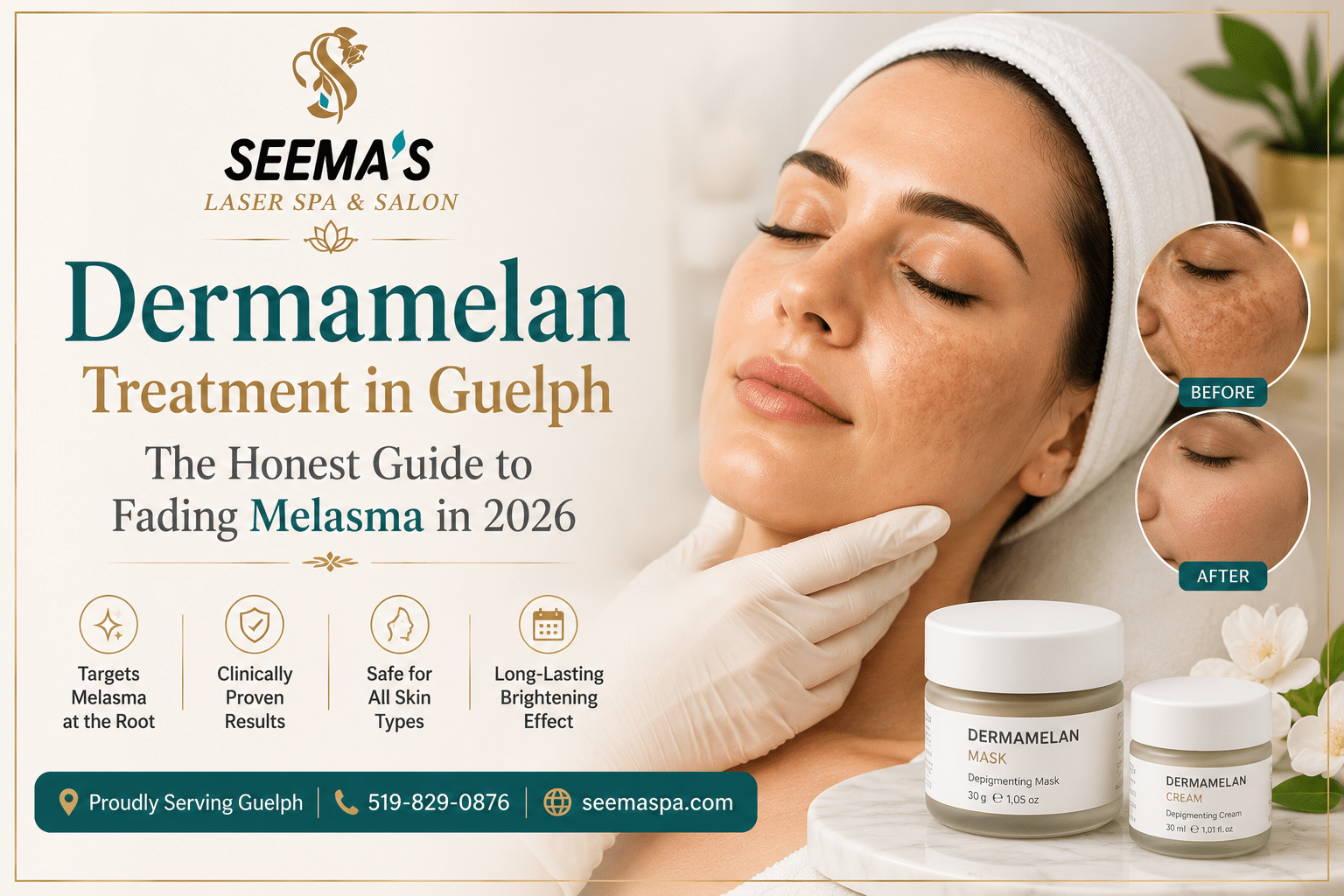
If you have spent the last few summers watching dark patches appear on your cheeks, forehead, or upper lip — trying cream after cream, SPF after SPF, and yet somehow the patches are back every July darker than they were the year before — this guide is for you.
You deserve an honest answer. Not a list of exaggerated promises. Not a treatment plan designed to keep you coming back indefinitely without results. Just a clear, factual explanation of what melasma actually is, why it is so difficult to treat, what Dermamelan does differently from everything else you may have already tried, and whether it is the right option for your skin in 2026.
At Seema’s Laser Spa & Salon in Guelph we offer Dermamelan treatment in Guelph — and this is the honest guide we wish every melasma client had read before spending money on treatments that were never going to work for their specific condition.
What Is Melasma — And Why Is It So Hard to Treat?
Melasma is a chronic skin condition that causes brown, grey-brown, or greyish patches to develop on the face — most commonly on the cheeks, forehead, bridge of the nose, upper lip, and chin. It is caused by an overproduction of melanin — the pigment that gives skin its colour — in specific areas of the face.
What makes melasma uniquely difficult to treat compared to regular sun spots or post-inflammatory pigmentation is its root cause. Melasma is driven by a combination of UV exposure and hormonal influence — which means it is not just sitting on the surface of the skin waiting to be bleached away. It is being actively produced by overactive melanocytes deep in the dermis, constantly regenerating pigment in response to sunlight and hormonal fluctuations.
This is why most people with melasma have a frustrating pattern of experience that goes something like this: the patches lighten slightly in winter, return in spring, and by July are darker than ever. The cycle repeats year after year because nothing they have tried has addressed the underlying overproduction mechanism — only the surface pigment.
Why Does Melasma Get Worse in Summer?
July is statistically the worst month of the year for melasma sufferers in Canada — and the reason is straightforward.
UV radiation is the primary external trigger for melanocyte activation. Even brief, incidental sun exposure — a walk to the car, sitting near a window, a weekend at a park — is enough to stimulate the overactive melanocytes responsible for melasma to produce more pigment. Longer days, stronger UV index, and more time spent outdoors in summer all combine to make July the peak month for melasma darkening across the country.
This also means that anyone trying to treat melasma in summer without adequate and consistent sun protection is fighting a battle they cannot win regardless of what treatment they are using. Dermamelan is highly effective — but it is not a substitute for daily SPF 50. It works with sun protection, not instead of it.
What Is Dermamelan Treatment?
Dermamelan is a professional depigmentation treatment developed by the Spanish skincare laboratory Mesoestetic — one of the most respected names in professional aesthetics globally. It is specifically designed to treat melasma and stubborn hyperpigmentation by targeting the enzyme responsible for triggering excess melanin production in the first place.
This is the critical distinction between Dermamelan and virtually every other pigmentation treatment you may have tried. Most brightening products — vitamin C serums, kojic acid creams, niacinamide formulations, and even many professional chemical peels — work by lightening pigment that has already formed on the surface of the skin. They address the symptom. Dermamelan addresses the source.
By inhibiting the tyrosinase enzyme — the key biological trigger in the melanin production process — Dermamelan interrupts the cycle of overproduction at its origin. This means that instead of simply fading existing patches while new ones continue forming underneath, the treatment works to stop new pigment from being generated while simultaneously fading what is already visible.
How Does Dermamelan Work — Step by Step?
The Dermamelan treatment at Seema’s Laser Spa Guelph works in two clearly defined phases:
Phase 1 — In-Clinic Mask Application
A concentrated Dermamelan depigmentation mask is applied directly to the skin during a single in-clinic appointment. The mask is worn for a period of hours — including overnight — and begins working immediately to interrupt the melanin production enzyme at the cellular level. This is a professional-grade formulation that is not available over the counter and cannot be replicated by any home skincare product.
Phase 2 — At-Home Mesoestetic Maintenance Program
Following the in-clinic appointment, a structured at-home skincare maintenance regimen using Mesoestetic professional products is followed consistently over several weeks. This phase continues to fade existing pigmentation, protects the skin barrier as it adjusts to treatment, and crucially — maintains the enzyme inhibition achieved during the in-clinic phase to prevent new pigment from regenerating.
The combination of both phases is what gives Dermamelan its clinical reputation. Neither phase works optimally without the other — the in-clinic application provides the deep disruption of the melanin production cycle, and the at-home program sustains and extends those results over the following weeks and months.
Is Dermamelan Better Than Other Melasma Treatments?
For true melasma specifically — yes, and significantly so for most skin types. Here is an honest comparison:
| Treatment | Works on True Melasma? | Depth of Action | Risk for Dark Skin | Downtime |
| Dermamelan | Yes — specifically designed for melasma | Deep — enzyme inhibition | Low — safe for all tones | 5-7 days peeling |
| Chemical Peel | Partial — surface pigment only | Surface to mid-dermis | Medium risk | 1-3 days |
| Laser (IPL/CO2) | Can worsen melasma | Surface | High risk for dark skin | 3-7 days |
| Brightening Facial | Minimal on true melasma | Surface only | Safe | None |
| Vitamin C Serum | Surface lightening only | Epidermis only | Safe | None |
The reason lasers can be counterproductive for melasma is important to understand. The heat generated by laser treatments can actually stimulate melanocytes — the very cells responsible for the overproduction — and in some cases cause a rebound darkening that makes melasma worse rather than better. Dermamelan avoids this risk entirely because it works through targeted enzyme inhibition rather than heat-based mechanisms.
Is Dermamelan Safe for Dark Skin Tones?
Yes — and this matters enormously for Guelph’s diverse community.
Melasma is significantly more prevalent in South Asian, Middle Eastern, Latin American, and Mediterranean skin tones. These are also the skin tones most frequently excluded from aggressive laser pigmentation treatments due to the risk of post-inflammatory hyperpigmentation — where the treatment itself triggers more dark spots.
Dermamelan was specifically developed with deeper skin tones in mind and has an established global clinical record of safe and effective use across all Fitzpatrick skin types. At Seema’s Laser Spa & Salon in Guelph our team has over 20 years of experience treating diverse skin tones and every Dermamelan treatment is preceded by a thorough skin assessment to confirm it is the most appropriate treatment for your specific complexion, pigmentation pattern, and skin history.
What Results Can You Realistically Expect?
This is where the honest part of this guide matters most — because melasma is a condition where exaggerated promises do real harm to people who have already been disappointed before.
What Dermamelan can realistically achieve:
- Significant visible reduction of existing melasma patches — most clients see 60 to 90 percent improvement after a full treatment cycle
- Disruption of the ongoing melanin overproduction cycle — breaking the pattern of patches returning as dark as before
- Visibly more even, clearer skin tone that is maintained with consistent aftercare
What Dermamelan cannot promise:
- Permanent elimination of melasma in all cases — melasma is a chronic condition and can recur with significant UV exposure or hormonal changes
- Results without consistent SPF use — sun protection is not optional with this treatment, it is essential
The clients who achieve the best and longest-lasting results from Dermamelan treatment at Seema’s are those who follow the at-home maintenance program consistently, wear SPF 50 daily without exception, and understand that maintaining results requires ongoing commitment to sun protection even after the visible patches have faded.
How Much Does Dermamelan Cost in Guelph?
Dermamelan pricing depends on the extent of pigmentation, the specific treatment protocol recommended for your skin type, and the at-home maintenance products included in your plan. Because melasma presentations vary significantly from person to person, Seema’s Spa & salon Book Appointment for Dermamelan treatment to assess your skin, confirm the diagnosis, and provide transparent pricing before you commit to any treatment.
Why Choose Seema’s for Dermamelan Treatment in Guelph
- One of the only clinics in Guelph offering Dermamelan and Mesoestetic professional depigmentation
- 20+ years of skin treatment experience — including extensive experience with diverse skin tones
- Safe for all Fitzpatrick skin types — including South Asian, Middle Eastern, and darker complexions
- 250+ five-star Google reviews from verified Guelph clients
- Free consultation before any treatment commitment
- Personalised treatment plans — never a generic one-size-fits-all approach
- Conveniently located at Hartsland Market Square, 210 Kortright Rd W, Guelph
Book Your Dermamelan Consultation in Guelph Today
If melasma has been affecting your confidence and you are tired of treatments that only partially work before the patches come back — Dermamelan at Seema’s Laser Spa & Salon is the treatment worth having an honest conversation about.
Address: 210 Kortright Rd W, Guelph, Ontario N1G 4X8
(Inside Hartsland Market Square)
Phone: +1 519-829-0876
Email: seema@seemaspa.com