
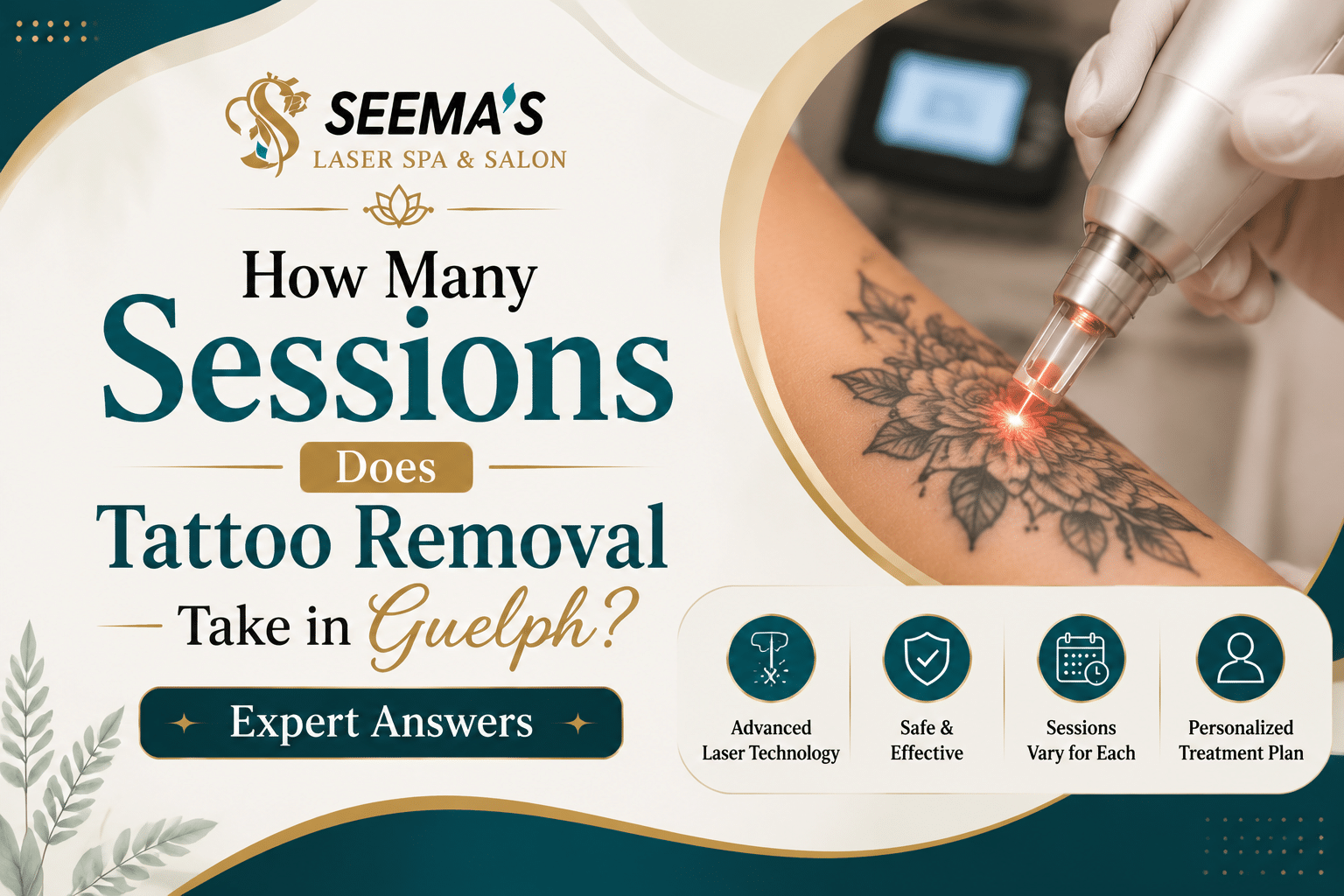
Before almost any other question — before asking about pain, before asking about cost, before asking about how the laser actually works — the first thing every single person searching for tattoo removal in Guelph wants to know is exactly the same thing.
How many sessions is this actually going to take?
It is the most honest, practical question anyone can ask before committing to a laser tattoo removal course. And yet it is also the question that gets the vaguest, most frustrating answers from most clinics — because the truthful answer requires more than a number. It requires context.
At Seema’s Laser Spa & Salon in Guelph we have been performing laser treatments for over 20 years. This guide gives you the clearest, most honest answer available to the session count question — including every factor that affects your individual number — so you can walk into your consultation knowing exactly what to expect.
So How Many Sessions Does Tattoo Removal Actually Take?
The honest answer for most clients is between 6 and 12 sessions for significant to complete removal.
That is a wide range — and the reason for the range is that tattoo removal in Guelph is not a standardised procedure. Every tattoo is different. Every skin type is different. Every immune system responds differently to the gradual clearance of shattered ink particles. A simple, small, black ink tattoo on a fair-skinned client in an easily accessible location might be fully removed in 5 to 7 sessions. A large, heavily saturated, multicoloured tattoo on darker skin in a difficult location might require 10 to 15 sessions or more.
The single most useful thing any Guelph clinic can do before starting your treatment is give you an honest, personalised session estimate based on a proper in-person assessment of your specific tattoo — not a flat number given over the phone to get you through the door.
What Actually Determines How Many Sessions You Need?
This is the most important section of this entire guide — because understanding the factors that affect your session count is what turns a vague estimate into a realistic expectation.
Factor 1 — The Kirby-Desai Scale
Professional laser clinics use a clinical assessment tool called the Kirby-Desai Scale to estimate the number of sessions a specific tattoo will require. It scores a tattoo across six key criteria:
| Criteria | Lower Score (Fewer Sessions) | Higher Score (More Sessions) |
| Skin type | Fair / light skin | Dark / deeper skin tone |
| Tattoo location | Upper body, close to lymph nodes | Extremities, hands, feet |
| Ink colours | Black only | Multiple colours including green, blue, yellow |
| Amount of ink | Light shading, minimal fill | Heavy saturation, solid fill |
| Scarring | No scarring | Existing scarring present |
| Tattoo age | 10+ years old | Less than 1 year old |
The higher the cumulative score, the more sessions the tattoo is estimated to require. At Seema’s every new tattoo removal consultation uses this framework to give you the most accurate possible session estimate before treatment begins.
Factor 2 — Ink Colour
Ink colour is one of the most significant determinants of session count — and one that most people do not fully understand before they book.
Black ink absorbs the broadest range of laser wavelengths and responds fastest to treatment. Black ink tattoos consistently require the fewest sessions and produce the most complete removal results.
Dark blue and dark green inks respond well to laser treatment but require more precise wavelength matching than black ink — taking slightly more sessions than pure black.
Red, orange, and brown inks respond moderately well to laser treatment but can occasionally cause unexpected skin reactions in some clients.
Light blue, light green, teal, and turquoise inks are among the most challenging colours to remove because they require very specific laser wavelengths to break down and do not respond efficiently to standard treatment protocols.
Yellow and white inks are the most difficult of all — they reflect rather than absorb laser energy, making them extremely resistant to standard removal and sometimes impossible to remove completely with laser alone.
If your tattoo contains multiple colours — particularly light blues, greens, or yellows — you should expect a higher session count than a comparable tattoo in black ink only. Your specialist at Seema’s will assess all colours present and provide a session estimate that accounts for the specific ink palette in your tattoo.
Factor 3 — Tattoo Age
Older tattoos are generally easier and faster to remove than newer ones — and the reason is biological rather than technical.
Over time the body’s immune system gradually breaks down and transports away the largest ink particles it can access — which is why tattoos naturally fade and blur over the years even without laser treatment. This means an older tattoo has already undergone partial natural clearance before laser treatment even begins.
A tattoo that is 10 or more years old will typically require significantly fewer sessions than an identical tattoo applied within the last 12 to 18 months. If you are considering laser removal of a fresh tattoo, it is worth knowing that waiting even a year or two before starting treatment can meaningfully reduce your total session count.
Factor 4 — Tattoo Location on the Body
Location affects session count through its relationship to lymphatic drainage — the biological mechanism that clears the shattered ink particles from the body after each laser session.
Tattoos located close to major lymph node clusters — the upper back, chest, and upper arms — tend to clear faster between sessions because the lymphatic system is more active and accessible in these areas. Tattoos on the extremities — hands, fingers, feet, and ankles — are further from major lymph nodes and tend to clear more slowly, requiring additional sessions to achieve comparable results.
Factor 5 — Ink Density and Saturation
A lightly shaded tattoo — like a watercolour style or minimalist fine-line design — contains significantly less ink per square centimetre than a solid, heavily filled tattoo. Less ink per session means each laser pulse has a smaller volume of target material to break down — and sessions produce visible progress more quickly.
A dense, heavily saturated tattoo — particularly one that has been coloured in solidly or built up through multiple sessions by the original artist — contains a much higher volume of ink at different depths within the dermis. These tattoos typically require more sessions to work through all layers of deposited ink.
Factor 6 — Your Immune System Response
This is the factor that is hardest to predict before treatment begins — but it matters enormously. The laser does not remove the ink directly. It shatters the ink into microscopic particles and your immune system then does the work of transporting those particles away through the lymphatic system over the following weeks.
Clients with efficient, active immune systems clear ink faster between sessions — sometimes showing dramatic fading within two to three weeks of a session. Clients whose immune systems respond more slowly may see minimal visible change for six to eight weeks before the full result of that session becomes apparent.
Supporting your immune system between sessions:
- Stay well hydrated — lymphatic clearance is significantly more efficient in hydrated tissue
- Exercise regularly — physical activity stimulates lymphatic circulation
- Avoid smoking — smoking demonstrably slows immune clearance of shattered ink particles and is one of the most consistent predictors of higher session counts
- Eat a nutrient-rich diet supporting immune function
How Far Apart Are Sessions Spaced?
Sessions at Seema’s are spaced a minimum of 6 to 8 weeks apart — and this spacing is not arbitrary. It is the minimum time needed for the body’s immune clearance process to work as completely as possible between sessions.
Booking sessions closer together than 6 weeks does not speed up the removal process — it simply treats skin that has not yet recovered from the previous session, increasing the risk of skin damage and producing worse results per session. Patience between appointments is one of the most important contributors to good tattoo removal outcomes.
For clients whose skin responds more slowly or whose tattoos are in extremity locations with slower lymphatic drainage, 8 to 10 weeks between sessions may produce better per-session results than the minimum 6-week interval.
Can a Tattoo Be Completely Removed?
For the vast majority of tattoos — yes, complete or near-complete removal is achievable with a full course of laser sessions at Seema’s.
Most likely to achieve complete removal:
- Black ink tattoos on fair to medium skin tones
- Amateur tattoos with less dense ink
- Older tattoos that have already faded naturally
- Tattoos in upper body locations
May achieve significant fading but not complete removal:
- Tattoos containing light blues, greens, yellows, or white
- Very heavily saturated professional tattoos
- Tattoos with scarring present from the original application
Even in cases where complete removal is not achievable, significant fading to the point where a cover-up tattoo becomes viable is almost always possible.
What About Tattoo Fading for Cover-Up?
Many clients are not seeking complete removal — they want their existing tattoo faded enough for a cover-up tattoo to work effectively. This typically requires significantly fewer sessions than complete removal — often just 2 to 5 sessions depending on the tattoo’s density and colour.
If cover-up fading is your goal rather than complete removal, let your specialist at Seema’s know from the start — the treatment plan and session spacing can be adjusted accordingly.
Learn More – The Complete Guide to Laser Tattoo Removal in Guelph: How It Works, Cost, Recovery & Best Aftercare Tips
How Much Does Tattoo Removal Cost in Guelph?
Pricing at Seema’s is based on the size of the tattoo, the number of sessions included in your plan, and the complexity of the removal. A free consultation is offered to assess your tattoo properly and provide transparent, accurate pricing before you commit to any treatment.
Why Choose Seema’s for Tattoo Removal in Guelph
- 20+ years of laser treatment experience in Guelph
- Proper Kirby-Desai assessment before every new client’s first session
- Honest, realistic session estimates — not a flat number to get you booked
- Certified laser specialists with experience across all skin tones and tattoo types
- Free consultation with transparent pricing before any commitment
- 280+ five-star Google reviews from verified Guelph clients
- Conveniently located at Hartsland Market Square, 210 Kortright Rd W, Guelph
Book Your Tattoo Removal Consultation in Guelph Today
If you have been putting off tattoo removal because you did not know what to expect or how long it would take — you now have the clearest possible picture of the process. The best next step is a free in-person consultation at Seema’s where your specific tattoo can be assessed and a personalised, honest treatment plan built around your individual situation.
Address: 210 Kortright Rd W, Guelph, Ontario N1G 4X8
(Inside Hartsland Market Square)
Phone: +1 519-829-0876
Email: seema@seemaspa.com