
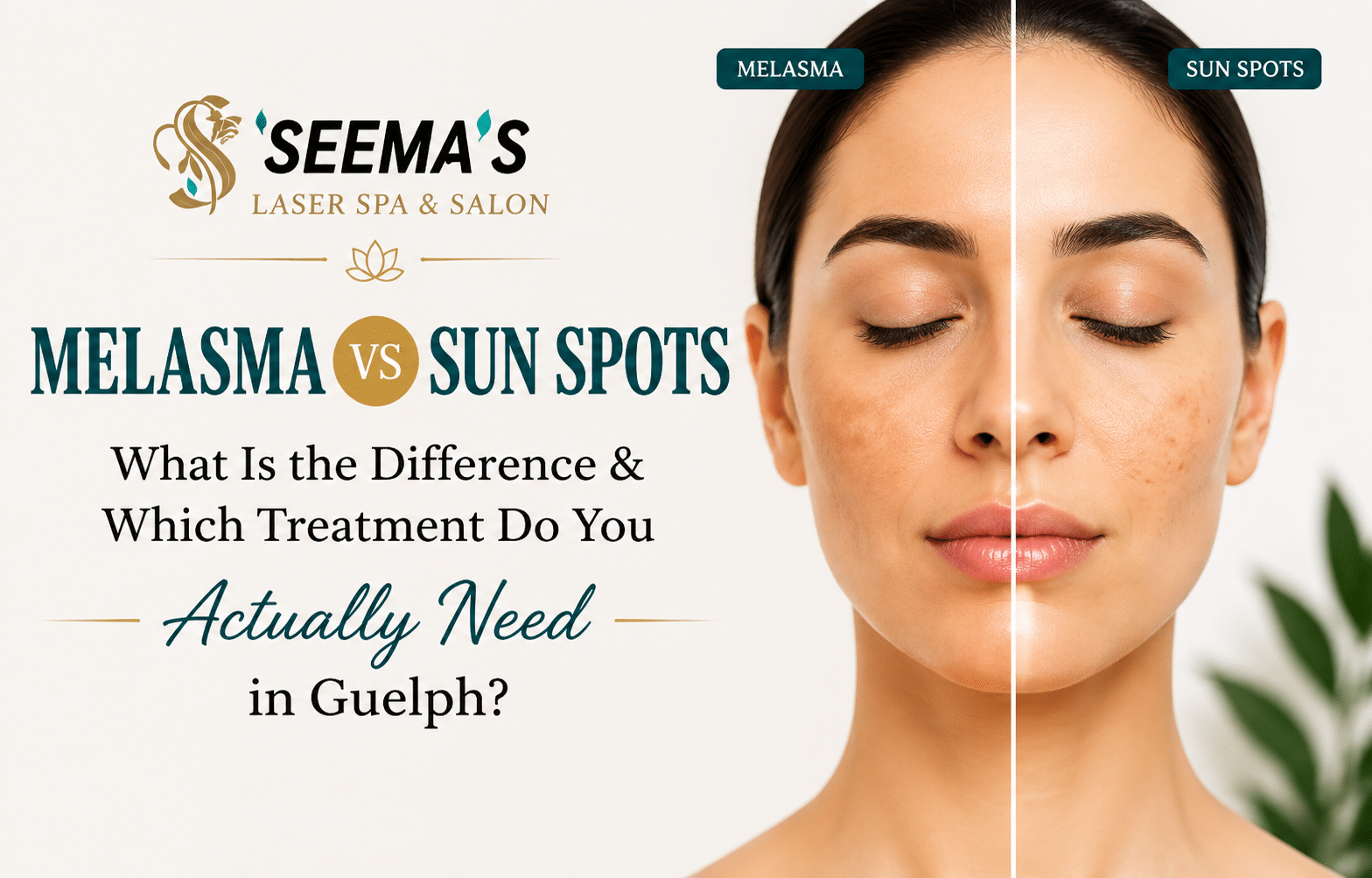
You have noticed dark patches on your face. Maybe they appeared gradually over several summers. Maybe they showed up suddenly after a pregnancy. Maybe they seem to get darker in July and lighter in January. Or maybe they appeared after a breakout cleared and have been sitting stubbornly on your skin ever since.
Whatever the pattern — the first and most important question is one that most people cannot answer on their own:
Is this melasma, sun spots, or something else entirely?
It matters enormously. Because melasma, sun spots and post-inflammatory hyperpigmentation are three completely different conditions — caused by different mechanisms, driven by different triggers and requiring different treatments to address. A treatment that works brilliantly for sun spots can actually worsen melasma. And a treatment that clears post-inflammatory hyperpigmentation may do very little for true melasma.
At Seema’s Laser Spa & Salon in Guelph we assess and treat all three conditions — and this guide is designed to help you understand the difference so you can walk into your consultation knowing exactly which question you are asking.
What Is Melasma?
Melasma is a chronic skin condition that causes symmetrical brown or grey-brown patches to develop on the face — most commonly on the cheeks, forehead, upper lip, bridge of the nose, and chin. It occurs when melanocytes — the pigment-producing cells in the skin — become overactive and produce excess melanin in specific areas.
What makes melasma distinct from other types of pigmentation is its root cause. Melasma is driven by a combination of two primary triggers working together:
Hormonal influence — melasma is strongly associated with elevated or fluctuating oestrogen and progesterone levels. This is why it is extremely common during pregnancy, is frequently triggered by hormonal contraception and often appears or worsens during perimenopause and menopause. The hormonal connection is so consistent that melasma has historically been called the “mask of pregnancy.”
UV exposure — sunlight activates the overactive melanocytes responsible for melasma and drives ongoing pigment production. Even brief, incidental sun exposure — walking to the car, sitting near a window — is enough to maintain or worsen melasma in susceptible individuals.
The critical detail that distinguishes melasma from other pigmentation is that it is being actively produced by overactive cells at a deep level in the dermis — not just sitting on the surface. This is why surface treatments that work on other types of pigmentation often fail to produce lasting results on true melasma.
Who gets melasma:
Melasma affects women significantly more than men — approximately 90 percent of cases occur in women. It is more prevalent in people with naturally deeper skin tones including South Asian, Middle Eastern, Latin American and Mediterranean complexions. However it can and does affect people of all skin tones and backgrounds.
How to recognise melasma:
- Symmetrical patches — both cheeks, both sides of the forehead, both sides of the upper lip
- Greyish-brown or brown in colour
- Irregular but defined edges
- Visibly darker in summer and slightly lighter in winter
- Worsens during pregnancy, while taking hormonal contraception, or during hormonal shifts
- Does not correspond to specific sun exposure incidents — appears diffusely
What Are Sun Spots?
Sun spots — also called age spots, liver spots, or solar lentigines — are flat, well-defined areas of darkened pigmentation caused directly and specifically by accumulated UV exposure over time. They are the skin’s response to years of sun damage — an overproduction of melanin in localised areas as a direct result of UV radiation hitting the skin.
Unlike melasma which is driven by a combination of hormonal and UV factors working together, sun spots are caused by UV exposure alone — with no meaningful hormonal component. They represent a permanent change in the skin’s pigment-producing behaviour in the specific areas that have received the most cumulative sun exposure over a lifetime.
Who gets sun spots:
Sun spots become increasingly common from the mid-30s onward as cumulative UV exposure accumulates. They are more common in fair-skinned individuals who burn easily, in people who spent significant time outdoors without sun protection and in areas of the body that receive the most sun exposure — face, hands, décolletage, shoulders and forearms.
How to recognise sun spots:
- Well-defined, round or oval in shape
- Flat against the skin surface
- Light tan to dark brown in colour — rarely grey
- Located on areas with the most historical sun exposure
- Do not correspond to hormonal changes or pregnancy
- Do not typically worsen dramatically in summer the way melasma does
- Tend to increase in number and darken gradually with age and continued sun exposure
What Is Post-Inflammatory Hyperpigmentation?
Post-inflammatory hyperpigmentation — commonly abbreviated as PIH — is the third major type of facial pigmentation that is frequently confused with melasma and sun spots. It occurs when an inflammatory event in the skin — most commonly acne, but also eczema, a cut, a burn, or any other wound — triggers excess melanin production in the healing process, leaving a dark mark behind after the original wound has healed.
PIH is essentially a scar of pigmentation rather than a structural scar. It is more common and more severe in darker skin tones because deeper complexions produce more melanin in response to inflammation.
How to recognise PIH:
- Dark marks that appear specifically where a pimple, wound, or inflammatory event previously occurred
- Flat, not raised
- Can be pink, red, brown, or very dark depending on skin tone
- Improves gradually over time on its own — unlike melasma which tends to stay or worsen
- No connection to hormonal changes
- No correlation with seasonal sun exposure patterns
How to Tell the Difference — Side by Side
| Melasma | Sun Spots | Post-Inflammatory Hyperpigmentation | |
| Pattern | Symmetrical patches | Random individual spots | Located where inflammation occurred |
| Colour | Brown or grey-brown | Tan to dark brown | Pink, red, brown, or very dark |
| Shape | Irregular but diffuse | Well-defined, round/oval | Matches shape of original lesion |
| Trigger | Hormones + UV exposure | UV exposure only | Skin inflammation or injury |
| Seasonal pattern | Significantly worse in summer | Gradual increase with age | No seasonal pattern |
| Common locations | Cheeks, forehead, upper lip | Face, hands, shoulders | Wherever acne or wounds occurred |
| Hormonal link | Strong — pregnancy, contraception | None | None |
| Natural progression | Chronic — returns without treatment | Stable to slowly increasing | Gradually fades over 6-24 months |
Why Does Pigmentation Get Worse in Summer in Guelph?
All three types of pigmentation can be worsened by UV exposure — but melasma responds most dramatically and most quickly to summer sunlight.
The elevated UV index throughout June, July and August in Guelph activates melanocytes across the board. For melasma sufferers — whose melanocytes are already in a state of chronic overactivation — even moderate summer sun exposure produces a rapid and visible darkening of existing patches. This is why so many people in Guelph notice their facial pigmentation significantly worsening in July specifically and improving somewhat over winter — a pattern that is one of the most reliable diagnostic indicators of true melasma rather than sun spots or PIH.
Sun spots also tend to become slightly more visible in summer as surrounding skin tans and the contrast between the spot and surrounding skin increases. But the dramatic summer worsening pattern — where patches visibly darken week by week through July and August — is characteristic of melasma specifically.
Which Treatment Do You Actually Need?
This is the section everything else has been building toward — and the answer depends entirely on which condition you are actually dealing with.
For Melasma:
Dermamelan & Mesoestetic Treatment
The Dermamelan treatment at Seema’s is the most clinically appropriate treatment for true melasma because it specifically targets the tyrosinase enzyme responsible for triggering excess melanin production — interrupting the overproduction cycle at its biological source rather than just treating the surface pigment. It is safe for all skin tones and specifically designed for hormonal pigmentation.
What does NOT work for melasma:
Standard lasers — including IPL — can actually worsen melasma by generating heat that stimulates already-overactive melanocytes. This is one of the most common and most costly mistakes made when melasma is misidentified as sun spots and treated with laser accordingly. This is why accurate diagnosis before treatment is essential.
Daily SPF 50: Non-negotiable for all melasma treatment. Without consistent sun protection, any treatment for melasma will produce only temporary results as ongoing UV exposure immediately restimulates pigment production.
For Sun Spots:
Redtouch Laser Therapy
The Redtouch Laser at Seema’s selectively targets melanin deposits in well-defined sun spots — breaking them down without affecting surrounding skin. Because sun spots are localised and UV-driven rather than hormonally driven, laser treatment is highly effective and does not carry the worsening risk that exists with laser on true melasma.
Chemical Peel
A professionally applied glycolic or TCA chemical peel accelerates cell turnover and gradually clears sun damage across the surface and upper dermis — an effective option for diffuse sun damage with multiple spots.
CoolPeel CO2 Laser
The CoolPeel treatment at Seema’s delivers fractional CO2 resurfacing that addresses sun damage, age spots and texture simultaneously — ideal for clients whose primary concern is cumulative sun damage across a broad facial area.
For Post-Inflammatory Hyperpigmentation:
Chemical Peel with BHA
A salicylic acid chemical peel targets the post-inflammatory pigmentation in the dermis while simultaneously addressing any ongoing breakouts that might be creating new PIH marks.
Brightening Facial
A professional brightening facial at Seema’s uses active brightening ingredients at clinical concentrations to accelerate the natural fading of PIH marks — particularly effective for recent marks that have not yet become deeply established.
Secret RF Microneedling
For PIH marks that have become established over time and are resistant to surface treatments, Secret RF at Seema’s reaches the deeper dermis where older PIH pigmentation sits and stimulates the collagen remodelling that can clear stubborn marks more effectively than surface-level treatments.
Why Getting the Diagnosis Right Matters More Than Anything
The most important message in this entire guide is simple: treating the wrong condition with the wrong treatment wastes money, wastes time and in the case of melasma treated with the wrong laser — can actively make the condition significantly worse.
A professional assessment at Seema’s Laser Spa & Salon in Guelph will confirm exactly which type of pigmentation you are dealing with before any treatment recommendation is made. The patterns, distribution, seasonal behaviour, hormonal history and skin tone all factor into an accurate diagnosis — and an accurate diagnosis is the difference between a treatment that works and one that does not.
Why Choose Seema’s for Pigmentation Treatment in Guelph
- Dermamelan — the clinically proven melasma treatment, available at Seema’s
- Redtouch Laser — targeted sun spot treatment with minimal downtime
- CoolPeel CO2 — comprehensive sun damage resurfacing
- Brightening facials and chemical peels — for PIH and surface pigmentation
- 20+ years of skin treatment experience across all skin tones
- Free consultation — accurate diagnosis before any treatment commitment
- Safe for all skin tones — including darker complexions most prone to melasma
- 280+ five-star Google reviews from verified Guelph clients
- Conveniently located at Hartsland Market Square, 210 Kortright Rd W, Guelph
Book Your Pigmentation Consultation in Guelph Today
If you have dark patches or spots that have been bothering you and you are not sure whether it is melasma, sun spots, or something else — the most valuable thing you can do is book an appointment at Seema’s and let a trained specialist give you an accurate answer.
Address: 210 Kortright Rd W, Guelph, Ontario N1G 4X8
(Inside Hartsland Market Square)
Phone: +1 519-829-0876
Email: seema@seemaspa.com