
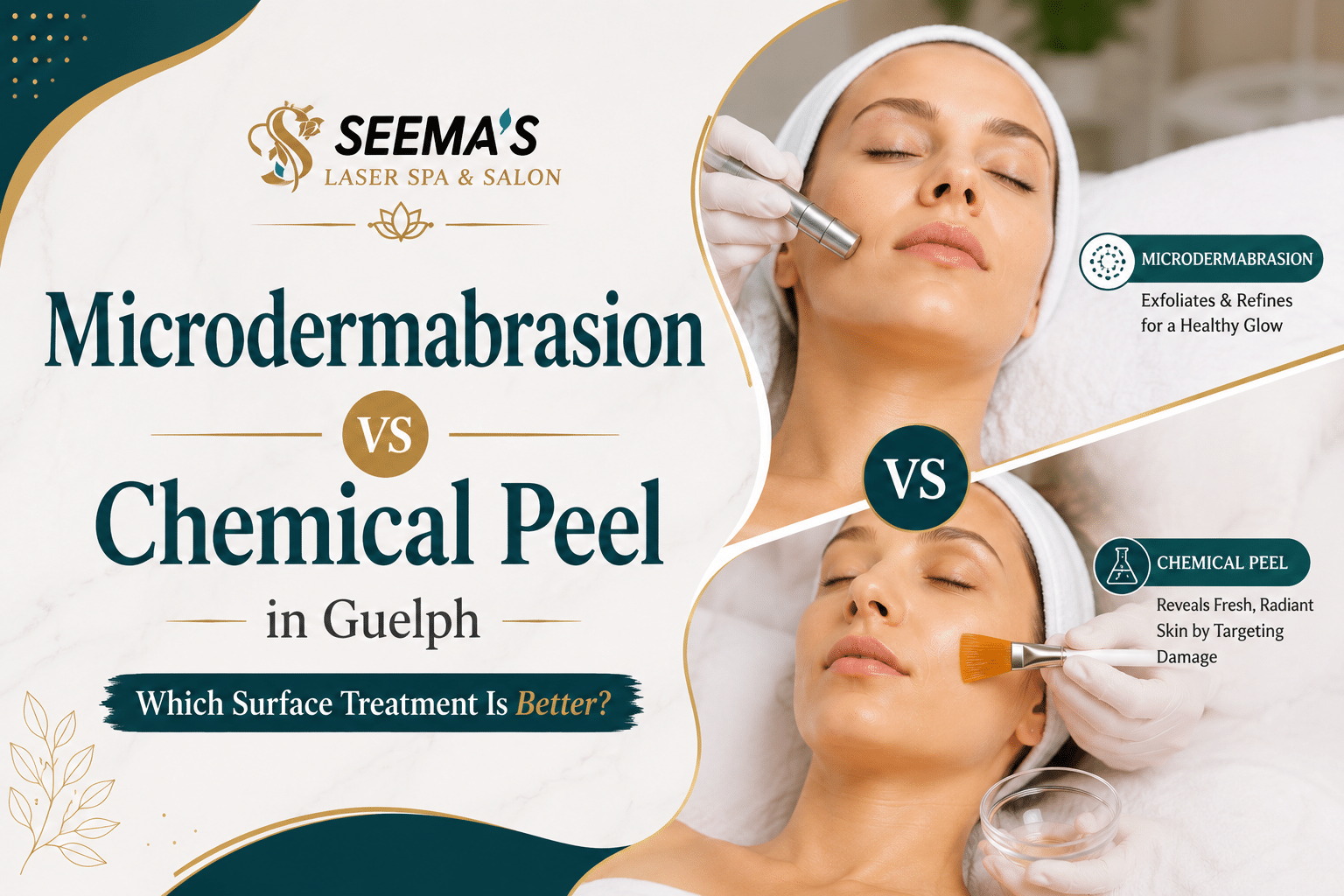
You have done your research. You know you want a professional skin treatment. You have narrowed it down to two options — microdermabrasion and chemical peel — and now you need someone to give you a straight, honest answer about which one is actually better for your skin.
That is exactly what this guide is going to do.
At Seema’s Laser Spa & Salon in Guelph we offer both microdermabrasion and chemical peel treatments — and because we offer both, we have absolutely no reason to push you toward one over the other. What we do have is over 20 years of experience helping Guelph clients choose the right treatment for their specific skin concern, skin type, and budget. This is the honest comparison guide you deserve before you book.
What Is Microdermabrasion?
Microdermabrasion is a non-chemical physical exfoliation treatment that uses a device fitted with a fine abrasive tip or crystal delivery system to mechanically remove the outermost layer of dead skin cells from the surface of the skin. The device simultaneously vacuums away the removed cells, leaving the skin immediately smoother and brighter.
The treatment works entirely at the level of the stratum corneum — the outermost layer of the epidermis — making it the most superficial of all professional skin resurfacing treatments. It does not penetrate into the living skin layers below the surface and does not trigger any meaningful cellular response beyond the immediate physical removal of dead surface cells.
What microdermabrasion does well:
- Instantly brightens dull, tired-looking skin
- Smooths rough surface texture
- Reduces the appearance of surface-level fine lines
- Improves the absorption of skincare products applied after treatment
- Clears minor surface congestion and blackheads
- Gives an immediate glow before an event
What microdermabrasion cannot do:
- Treat deeper pigmentation or melasma
- Stimulate meaningful collagen production
- Address post-inflammatory hyperpigmentation from acne
- Significantly reduce deeper wrinkles
- Improve skin laxity or firmness
Downtime: Zero to minimal. Skin may appear slightly pink for a few hours.
Session length: 30 to 45 minutes
Sessions needed: 4 to 6 for sustained improvement — one session produces temporary results only
What Is a Chemical Peel?
A chemical peel uses a specifically formulated acid solution — applied directly to the skin surface — to dissolve the bonds holding dead and damaged skin cells together, triggering controlled exfoliation at a depth determined by the type and concentration of acid used.
Unlike microdermabrasion which physically abrades the surface, a chemical peel works through a chemical process that can be calibrated to reach different depths within the skin — from a superficial peel targeting the epidermis only, to a medium peel reaching into the upper dermis, to a deep peel reaching the mid-dermis. At Seema’s Laser Spa & Salon the chemical peels offered are professional-grade formulations that produce clinically meaningful results — not the diluted versions available in home peel kits.
Types of chemical peels available:
Superficial Peel (AHA/BHA — Glycolic, Lactic, Salicylic):
Works within the epidermis. Ideal for brightening, mild pigmentation, acne-prone skin, and surface texture. Minimal downtime. Can be used regularly every 4 to 6 weeks.
Medium Peel (TCA — Trichloroacetic Acid):
Penetrates into the upper dermis. Addresses moderate pigmentation, sun damage, more established fine lines, and uneven skin tone more effectively than superficial peels. Some peeling and downtime of 3 to 7 days.
What chemical peels do well:
- Significantly reduce pigmentation and uneven skin tone
- Address post-inflammatory hyperpigmentation from acne
- Improve moderate sun damage and age spots
- Stimulate collagen production in the upper dermis (medium peels)
- Reduce active acne and congestion
- Improve fine lines more meaningfully than microdermabrasion
What chemical peels cannot do:
- Treat deep structural skin laxity
- Replace laser resurfacing for significant textural concerns
- Produce results in a single session for established pigmentation
Downtime: Superficial — 1 to 2 days of mild sensitivity. Medium — 3 to 7 days of visible peeling.
Session length: 30 to 60 minutes
Sessions needed: 3 to 6 for sustained improvement depending on peel depth and skin concern
What Is the Actual Difference Between Them?
This is the core of the comparison — and the table below gives you the clearest side by side answer:
| Microdermabrasion | Chemical Peel | |
| How it works | Physical abrasion | Chemical exfoliation |
| Depth of treatment | Epidermis surface only | Epidermis to upper dermis |
| Collagen stimulation | Minimal | Yes — medium peels |
| Best for pigmentation | Surface only | More effective |
| Best for texture | Immediate improvement | Deeper improvement |
| Best for acne | Surface congestion | Active acne + marks |
| Best for fine lines | Mild surface lines | More established lines |
| Downtime | None | 1 to 7 days |
| Sensitivity risk | Very low | Low to moderate |
| Safe for sensitive skin | Yes | Depends on peel type |
| Results per session | Immediate but temporary | Cumulative and longer-lasting |
| Available at Seema’s | Yes | Yes |
Which Is Better for Specific Skin Concerns?
Acne and Congested Skin
Both treatments address acne-related concerns but in different ways. Microdermabrasion physically unclogs pores and removes the surface buildup that contributes to blackheads and mild congestion. A salicylic acid chemical peel goes deeper — penetrating into the pore itself to dissolve sebum buildup and kill acne-causing bacteria at the follicular level. For active acne and post-acne marks — chemical peel is the stronger choice.
Pigmentation and Dark Spots
Microdermabrasion addresses surface-level dullness but cannot meaningfully fade true pigmentation or post-inflammatory hyperpigmentation. A glycolic acid or TCA peel penetrates to the level where melanin deposits sit and accelerates the cell turnover that gradually clears them. For pigmentation concerns — chemical peel is significantly more effective.
Uneven Skin Tone
For general dullness and mild unevenness, microdermabrasion delivers an immediate glow. For established uneven skin tone caused by sun damage, hormonal pigmentation, or post-acne marks — a chemical peel reaches the depth where meaningful correction occurs.
Fine Lines and Early Wrinkles
Microdermabrasion softens the appearance of very fine surface lines by smoothing the outer skin layer. A medium-depth chemical peel stimulates collagen in the upper dermis — producing improvement in more established lines that microdermabrasion cannot address. For fine lines — chemical peel wins for longer-lasting results.
Sensitive Skin
Microdermabrasion is the gentler option for clients with sensitive or reactive skin because it involves no chemical agents and produces no inflammatory response beyond mild surface redness. Superficial chemical peels using lactic acid are also generally well-tolerated by sensitive skin, but the selection of the appropriate peel type requires careful assessment — which is exactly why every chemical peel at Seema’s begins with a full skin consultation.
Which Is More Painful and What Is the Downtime?
Microdermabrasion:
Not painful. The sensation is a mild abrasive pressure across the skin — most clients describe it as feeling like a cat’s tongue or fine sandpaper moving across the surface. Zero downtime in most cases. Skin may appear slightly flushed for 1 to 2 hours and then returns to normal completely.
Chemical Peel:
A mild warming or tingling sensation during application — more pronounced with higher concentration peels. Not typically described as painful by the majority of clients. Downtime varies by peel depth — superficial peels produce 1 to 2 days of mild sensitivity and possible light flaking, while medium peels produce 3 to 7 days of more visible peeling as treated skin sheds and reveals the newer skin beneath.
The peeling process with a medium chemical peel can feel alarming the first time — but it is the treatment working exactly as intended and the result on the other side is meaningfully clearer, smoother skin.
Who Should Choose Microdermabrasion and Who Should Choose Chemical Peel?
Choose microdermabrasion if you:
- Want an immediate glow with zero downtime
- Have very sensitive skin that reacts to chemical ingredients
- Are preparing for an event in the next 24 to 48 hours and want a surface refresh
- Are new to professional skin treatments and want a gentle starting point
- Have mild surface texture concerns and general dullness only
- Are maintaining already-healthy skin between other treatments
Choose chemical peel if you:
- Have pigmentation, sun damage, or post-acne marks you want to meaningfully fade
- Are dealing with active acne or congested skin beyond surface level
- Want collagen stimulation and longer-lasting improvement per session
- Are comfortable with a few days of downtime for a more significant result
- Have tried microdermabrasion and want to progress to something that goes deeper
- Are targeting a specific skin concern rather than a general glow
Can You Combine Microdermabrasion and Chemical Peel?
Yes — and in some cases combining the two treatments in a sequential protocol can enhance the result of the chemical peel specifically. Microdermabrasion performed before a chemical peel removes the outer layer of dead skin cells that can act as a barrier to acid penetration, allowing the chemical peel to work more evenly and effectively at a lower concentration.
However combining these treatments is not appropriate for every client or every skin type — and should only be done under the guidance of a trained skin specialist who has assessed your skin individually. At Seema’s every treatment plan is assessed and recommended on an individual basis — never a generic protocol applied to every client regardless of their skin.
What If Neither Treatment Is Strong Enough for My Skin?
This is an important question — and the honest answer is that both microdermabrasion and chemical peels are surface and near-surface treatments with real limitations. For clients with deeper skin concerns — significant skin laxity, deep acne scarring, stubborn melasma, or established wrinkles — the treatments that deliver more meaningful results are available at Seema’s:
- Secret RF Microneedling — reaches 3.5mm deep for structural collagen remodelling
- CoolPeel CO2 Laser — fractional resurfacing for deeper texture and pigmentation
- Dermamelan Treatment — enzyme-level depigmentation for true melasma
- HIFU V-MAX — deep structural lifting for skin laxity
Your free consultation at Seema’s will determine exactly which treatment level is appropriate for your specific skin concerns — surface, mid-level, or deep structural.
Learn More – Best Facials in Guelph for Acne, Anti-Aging & Sensitive Skin — A Complete Guide
How Much Do These Treatments Cost in Guelph?
Pricing for both microdermabrasion and chemical peel at Seema’s varies based on the specific treatment selected, the area being treated, and whether a package of sessions is included. Seema’s offers a free consultation to assess your skin and provide transparent pricing before you commit to any treatment.
Why Choose Seema’s for Microdermabrasion or Chemical Peel in Guelph
- Both treatments available — no bias toward one over the other
- Professional-grade formulations — not diluted versions
- 20+ years of skin treatment experience across all skin types and tones
- Free consultation before any treatment commitment
- Personalised assessment — the right treatment recommended for your specific skin
- 250+ five-star Google reviews from verified Guelph clients
- Full treatment menu — surface treatments through to advanced laser and RF options
- Conveniently located at Hartsland Market Square, 210 Kortright Rd W, Guelph
Book Your Skin Treatment Appointment in Guelph Today
If you are ready to move beyond home skincare and try a professional surface treatment — or if you have been choosing between microdermabrasion and chemical peel and are still not sure which one is right for your skin — the best next step is a free consultation at Seema’s.
Address: 210 Kortright Rd W, Guelph, Ontario N1G 4X8
(Inside Hartsland Market Square)
📞 Phone: +1 519-829-0876
📧 Email: seema@seemaspa.com
🌐 Book Online: seemaspa.com/customized-rejuvenation-facials/