
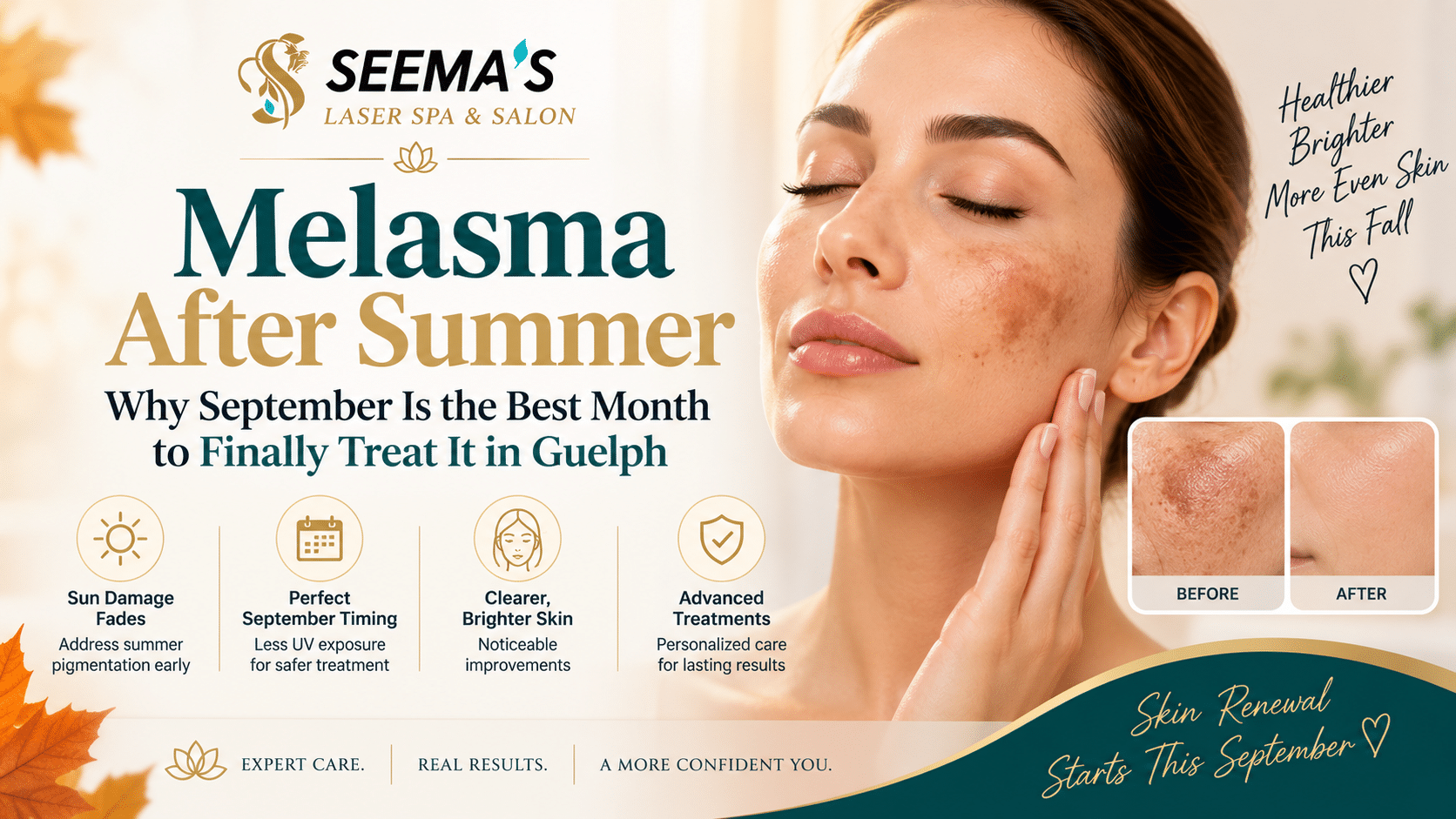
If your face is looking back at you in the mirror right now with darker patches than it had in May — you are not imagining it, and you are not alone.
Every September, thousands of people across Guelph and the Waterloo Region arrive at the same moment simultaneously. Three months of summer sun exposure. Three months of watching the patches on their cheeks, forehead, and upper lip get progressively darker week by week despite sunscreen, despite hats, despite everything they have tried. And now, as September arrives and the season finally begins to shift, they are done waiting and ready to do something about it.
If that is where you are right now — this guide is going to tell you something that will genuinely change how you think about the timing of your treatment.
September is not just an acceptable month to start treating your melasma. For most people it is the single most strategically advantageous month of the entire year to begin — and the reason is both scientific and practical.
At Seema’s Laser Spa & Salon in Guelph we offer Dermamelan treatment — one of the most clinically proven melasma depigmentation systems available anywhere in Ontario. This is the complete guide to why September timing matters, how the treatment works, and what you can realistically expect from starting your melasma journey this autumn.
Why Melasma Gets So Much Worse in Summer
To understand why September is the optimal treatment month, you first need to understand exactly what has been happening to your skin over the past three months — and why summer is so uniquely brutal for melasma sufferers.
Melasma is caused by an overactivation of melanocytes — the pigment-producing cells in the deeper layers of the skin. Unlike regular sun spots which are localised patches of accumulated UV damage, melasma involves melanocytes that are in a state of chronic hyperactivity — constantly producing more melanin than normal in specific facial areas in response to two simultaneous triggers: UV exposure and hormonal influence.
The UV exposure component is what makes summer so damaging. Every single UV photon that reaches an overactive melasma melanocyte acts as a direct trigger — stimulating it to produce more pigment immediately. Unlike healthy melanocytes which produce a measured response to sun exposure and then regulate back down, melasma melanocytes respond disproportionately and persistently to UV stimulation.
This is why melasma follows the pattern that virtually every sufferer recognises:
- May — patches begin to darken as UV index rises
- June — visible darkening accelerating as summer begins
- July — patches at their most prominent and darkest
- August — continued darkening despite sun protection
- September — UV index begins to drop, patches very slightly less stimulated
The cruel reality of summer with melasma is that even diligent SPF use often cannot fully prevent the worsening — because UV-A radiation, which penetrates through cloud cover and glass, continues to reach and stimulate melanocytes throughout the summer regardless of the SPF protection being applied to block UV-B.
Why September Melasma Looks Its Worst — and Why That Is Actually Good News
Here is the counterintuitive truth that most melasma sufferers do not know.
The reason September melasma looks so dark — darker than at any other point in the year — is that the summer’s accumulated UV stimulation has driven melanin production to its annual peak. The overactive melanocytes have been working overtime for three months and the visible result is all of that pigment sitting at or near the surface of the skin.
But here is why this is actually good news for treatment timing.
Dermamelan works by interrupting the enzyme responsible for driving this overproduction — stopping the melanin production mechanism at its source rather than just lightening what is already on the surface. When Dermamelan is applied to skin that is at its peak melanin production state — as it is in September — the treatment has access to the full extent of active pigmentation. It can address the complete picture of your melasma rather than a partially dormant winter version of it.
At the same time September brings something equally important: the beginning of the lower UV season. As UV index drops from September through February, the ongoing UV stimulation that drives melasma worsening naturally reduces. This creates the ideal window for the Dermamelan at-home maintenance program — the second phase of treatment — to work without constantly fighting against fresh UV-triggered pigment production.
Starting Dermamelan in September means the treatment begins at peak visibility and then works through the lowest UV months of the year. This combination consistently produces the best results in our experience at Seema’s — better than starting treatment in spring when UV is rising, and significantly better than attempting treatment in summer when ongoing UV exposure actively competes with the depigmentation process.
What Is Dermamelan Treatment?
Dermamelan Treatment is a professional depigmentation system developed by Mesoestetic — one of the most respected names in professional aesthetics globally — and it is specifically designed to treat melasma in a way that most other pigmentation treatments fundamentally cannot.
The critical distinction that makes Dermamelan different from everything else available in Guelph for melasma is its mechanism of action. Most brightening treatments — vitamin C serums, kojic acid products, niacinamide formulations, standard chemical peels, and even most laser-based pigmentation treatments — work on melanin that has already been produced and deposited in the skin. They address the visible pigment — the symptom — without touching the underlying mechanism that is continuously generating new pigment to replace what is removed.
This is why so many melasma sufferers have tried everything and had the same experience: temporary improvement followed by the patches returning, often darker than before.
Dermamelan works differently. It targets and inhibits tyrosinase — the enzyme that is the key biological trigger in the melanin production chain. By blocking tyrosinase activity in overactive melanocytes, Dermamelan interrupts the overproduction cycle at its source — stopping the generation of new excess pigment while simultaneously allowing existing pigmentation to fade as the skin’s natural renewal cycle progresses.
How Does the Dermamelan Treatment Work at Seema’s?
The Dermamelan treatment at Seema’s Laser Spa & Salon in Guelph is delivered in two clearly structured phases:
Phase 1 — In-Clinic Application (Single Appointment)
A concentrated Dermamelan depigmentation mask is applied directly to the skin in a single in-clinic session at Seema’s. The mask is worn for several hours — including overnight — and begins working immediately to inhibit the tyrosinase enzyme and interrupt the melanin production cycle in overactive melanocytes. This is a professional-grade formulation that is not available over the counter and cannot be replicated by home skincare products regardless of their price point.
Phase 2 — At-Home Mesoestetic Maintenance Program
Following the in-clinic application, a structured at-home skincare regimen using Mesoestetic professional products is followed consistently over several weeks and months. This phase serves three simultaneous functions: continuing to inhibit tyrosinase to prevent new pigment formation, supporting the gradual fading of existing visible pigmentation as the skin renews, and protecting and strengthening the skin barrier as it adjusts to the treatment protocol.
The two-phase combination is essential — neither phase works at its full potential without the other. The in-clinic application provides the deep disruption of the melanin production mechanism, and the at-home program sustains that disruption through the critical months when results are developing.
Why Autumn Is When the At-Home Phase Works Best
This is the specific detail that makes September the most strategically sound starting month of the entire year for Dermamelan treatment.
The at-home Mesoestetic maintenance phase works optimally in conditions of low UV exposure. When UV index is low — as it is consistently from September through February in Guelph — the melanocyte-inhibiting effects of the maintenance products can work without constant competition from fresh UV-triggered melanin stimulation.
Compare this to starting Dermamelan in May or June. The in-clinic phase is completed — but the at-home maintenance program then runs through the peak summer months when UV exposure is at its maximum. Every day of summer sun triggers melanocyte activity that the maintenance products must work against rather than with. The result is slower, less complete fading and a higher likelihood of early recurrence.
Starting in September means the entire at-home maintenance program runs through September, October, November, December, January, and February — six consecutive months of naturally low UV conditions where the treatment protocol can work exactly as designed with no seasonal interference.
By the time March arrives and UV begins to rise again, the treatment is complete, the melanin production cycle has been genuinely disrupted, and the skin has had its longest possible window to renew and reveal the depigmented result.
Is Dermamelan Safe for Darker Skin Tones in Guelph?
Yes — and this is critically important for Guelph’s diverse community.
Melasma is significantly more common in South Asian, Middle Eastern, Latin American, and Mediterranean skin tones. These same skin tones are also the most frequently harmed by inappropriate melasma treatments — particularly laser-based approaches that generate heat in the skin and can trigger post-inflammatory hyperpigmentation in deeper complexions, making the pigmentation problem significantly worse.
Dermamelan works through targeted enzyme inhibition rather than thermal energy — which means it does not carry the melanocyte-stimulating risk that heat-based treatments do for darker skin tones. It has a well-established global clinical record of safe and effective use across all Fitzpatrick skin types and is specifically used in countries with predominantly darker-skinned populations — including India, Brazil, and across the Middle East — where melasma rates are highest.
At Seema’s Laser Spa & Salon our team has over 20 years of experience treating the full range of skin tones across Guelph and the Waterloo Region. Every Dermamelan consultation includes a thorough skin assessment to confirm Dermamelan is the most appropriate treatment for your specific complexion, pigmentation pattern, and skin history.
Learn more – Melasma vs Sun Spots — What is the Difference & Which Treatment Do You Actually Need in Guelph?
What Results Can You Realistically Expect This Autumn?
This is where honest expectation-setting matters most — because melasma is a condition where exaggerated promises have done real harm to people who have already been disappointed by treatments that did not deliver.
What most clients experience after starting Dermamelan in September:
Weeks 1 to 2 — Peeling phase
In the days following the in-clinic application, visible peeling and flaking occurs as the treated skin surface sheds. This is not a side effect — it is the treatment working as designed. The peeling phase typically lasts 5 to 7 days. Skin may feel tight and appear visibly flaky during this period.
Weeks 3 to 6 — Early fading begins
As the peeling phase completes and the at-home maintenance program takes full effect, early visible lightening of existing patches begins. Skin tone starts to even out and the darkest areas of pigmentation begin to fade.
Months 2 to 4 — Progressive improvement
The most significant and visible improvement typically occurs during this phase as the at-home maintenance program continues to inhibit new pigment formation while the skin’s natural 28-day renewal cycle progressively clears existing deposits. Most clients see 60 to 90 percent improvement in patch visibility during this window.
By February or March — Full result visible
For clients who start in September and follow the maintenance program consistently, the full Dermamelan result is typically visible by late winter — skin that is significantly clearer, more even-toned, and genuinely transformed compared to how it looked at the end of August.
What Dermamelan cannot promise:
Dermamelan can produce long-lasting results — but melasma is a chronic condition. Without consistent daily SPF 50 use and appropriate maintenance, pigmentation can return when UV exposure resumes in spring. The clients who maintain their results longest are those who commit to SPF protection and periodic maintenance treatments.
How Much Does Dermamelan Treatment Cost in Guelph?
Pricing depends on the extent of pigmentation, the specific maintenance products included, and the personalised treatment protocol recommended for your skin. Because melasma presentations vary significantly, Seema’s offers Book an Appointment to assess your specific pigmentation pattern and provide transparent pricing before any treatment commitment is made.
Why Choose Seema’s for Melasma Treatment in Guelph This September
- Dermamelan and Mesoestetic — clinically proven melasma depigmentation available at Seema’s
- One of the only clinics in Guelph offering this specific treatment system
- 20+ years of skin treatment experience including extensive experience treating diverse skin tones
- Safe for all Fitzpatrick skin types — including South Asian, Middle Eastern, and darker complexions
- Free consultation before any treatment commitment
- Personalised treatment plan — never a generic protocol
- 280+ Google reviews from verified Guelph clients
- Conveniently located at Hartsland Market Square, 210 Kortright Rd W, Guelph
- Welcoming clients from Guelph, Kitchener, Waterloo, and Cambridge
Book Your September Melasma Appointment in Guelph Today
If this summer was the summer that finally made you ready to do something real about your melasma — September is the month to act on that decision. Not because any month is bad for starting treatment. But because this specific month, at this specific point in the UV calendar, with the Dermamelan protocol running through the lowest UV season of the year, gives your skin the best possible conditions for the most complete and longest-lasting result.
Do not let another summer go by looking the same way.
Address: 210 Kortright Rd W, Guelph, Ontario N1G 4X8
(Inside Hartsland Market Square)
Phone: +1 519-829-0876
Email: seema@seemaspa.com